Mahjong Cheat Sheet – Printable Rules Guide
Use and print a free mahjong cheat sheet covering suits, honors, groups, turn order, win checks, plus separate reminders for riichi and American rules.
Quick answer
This mahjong cheat sheet offers three separate downloads: a shared tile-and-turn reference, a riichi decision sheet, and an American card-check sheet. Use the one that matches your table. None replaces its full rules, scoring table, or current annual card.
Mahjong beginner cheat sheet
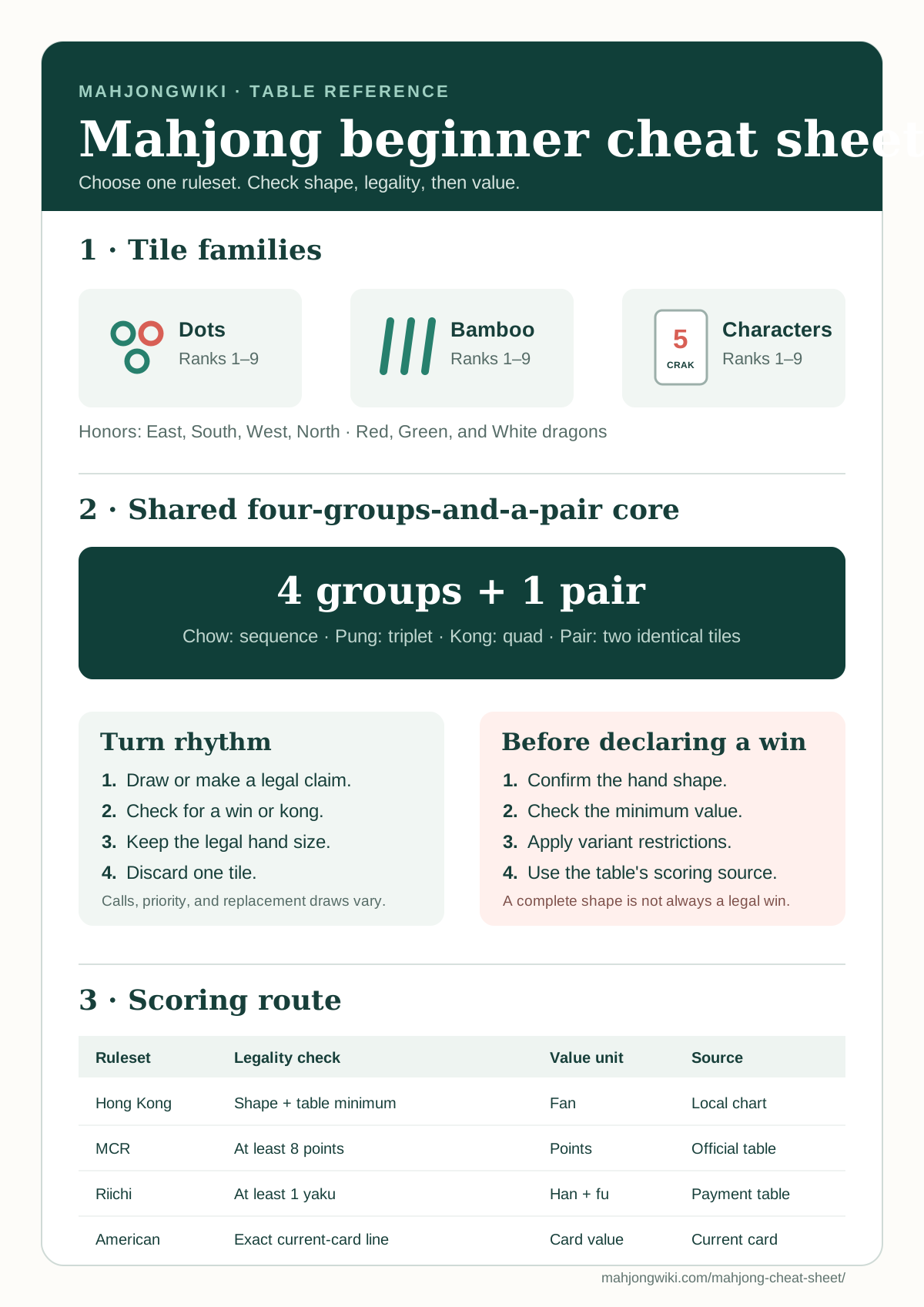
Use this shared core for four-groups-and-a-pair mahjong. Check the variant panel before applying a rule at the table.
DotsRanks 1–9
BambooRanks 1–9
CharactersRanks 1–9
Tile families
3 numbered suits: Dots, Bamboo, Characters
Honors: East, South, West, North, plus Red, Green, and White dragons
Standard groups
Chow: 3 consecutive tiles in 1 suit
Pung: 3 identical tiles
Kong: 4 identical tiles
Pair: 2 identical tiles
Turn rhythm
- Draw or claim a legal discard.
- Check for a win or kong.
- Keep the legal hand size.
- Discard 1 tile.
Standard shape
4 groups + 1 pair
A kong still counts as 1 group. Special hands can break this shape.
Before claiming
- Name the allowed call.
- Expose the completed group.
- Take the correct discard.
- Finish by discarding if required.
Before declaring a win
- Confirm the shape.
- Check the minimum value.
- Check restrictions such as furiten.
- Use the table’s scoring source.
Riichi additions
A complete hand needs at least 1 yaku. Track seat wind, round wind, dora, closed/open status, and furiten. Dora adds value but is not a yaku by itself.
American additions
Use the current card. Build the printed combination exactly, observe concealed/exposed labels, use jokers only where permitted, and follow Charleston procedure.
| Ruleset | First legality check | Value unit | Use next |
|---|---|---|---|
| Hong Kong | Complete shape and table minimum | Fan | Local fan and payout chart |
| MCR | At least 8 recognized points | Points | Official combination table |
| Riichi | At least 1 yaku | Han + fu | Payment table after limits |
| American | Exact current-card line | Printed card value | Current card and table rules |
Riichi table check
Use a named riichi rulebook; these checks do not replace its yaku list or payment table.
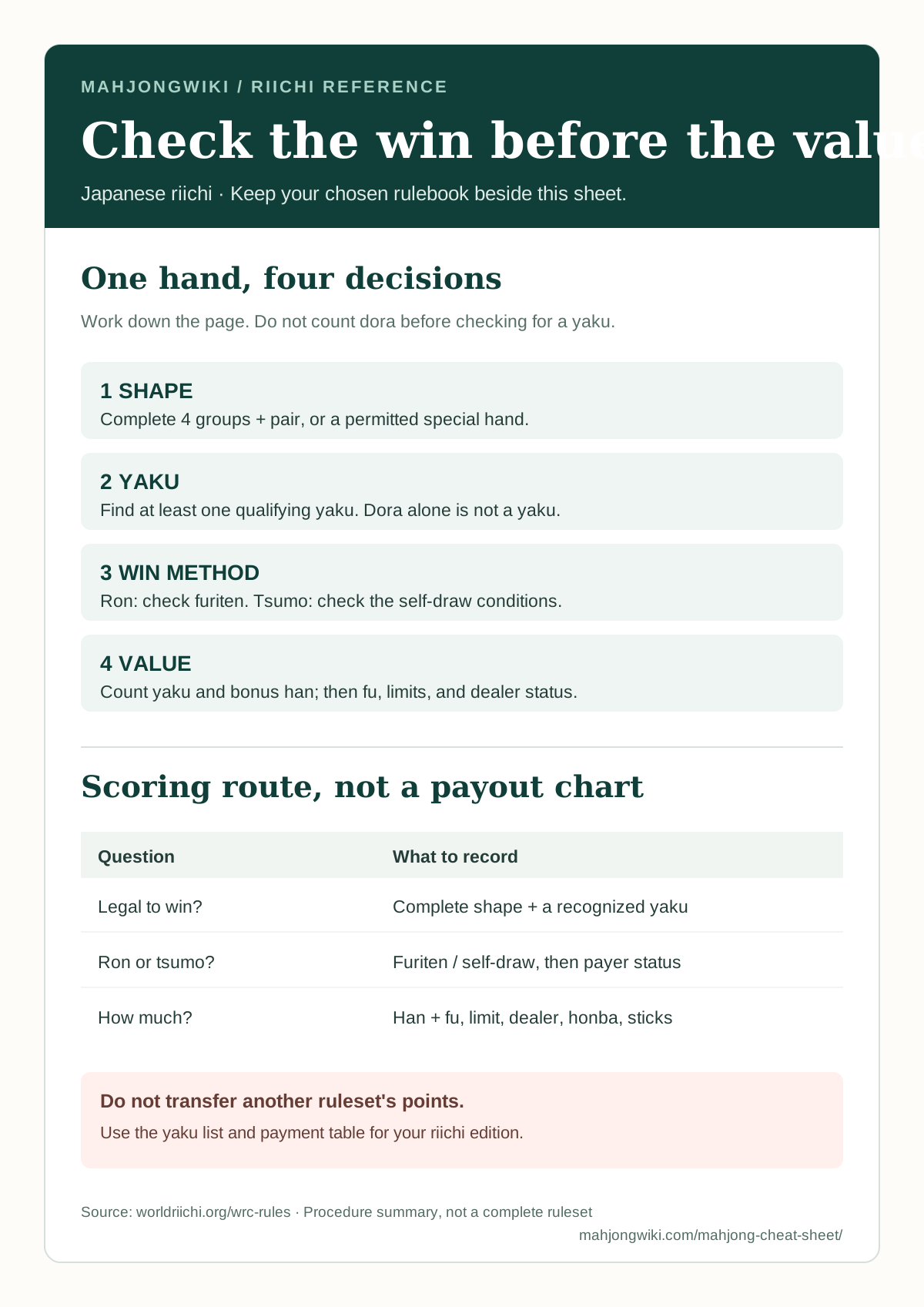
- Is the hand complete and does it contain a yaku?
- Is ron blocked by furiten? Tsumo remains a separate check.
- Only after legality: count yaku and bonus han, then fu and limits.
American card check
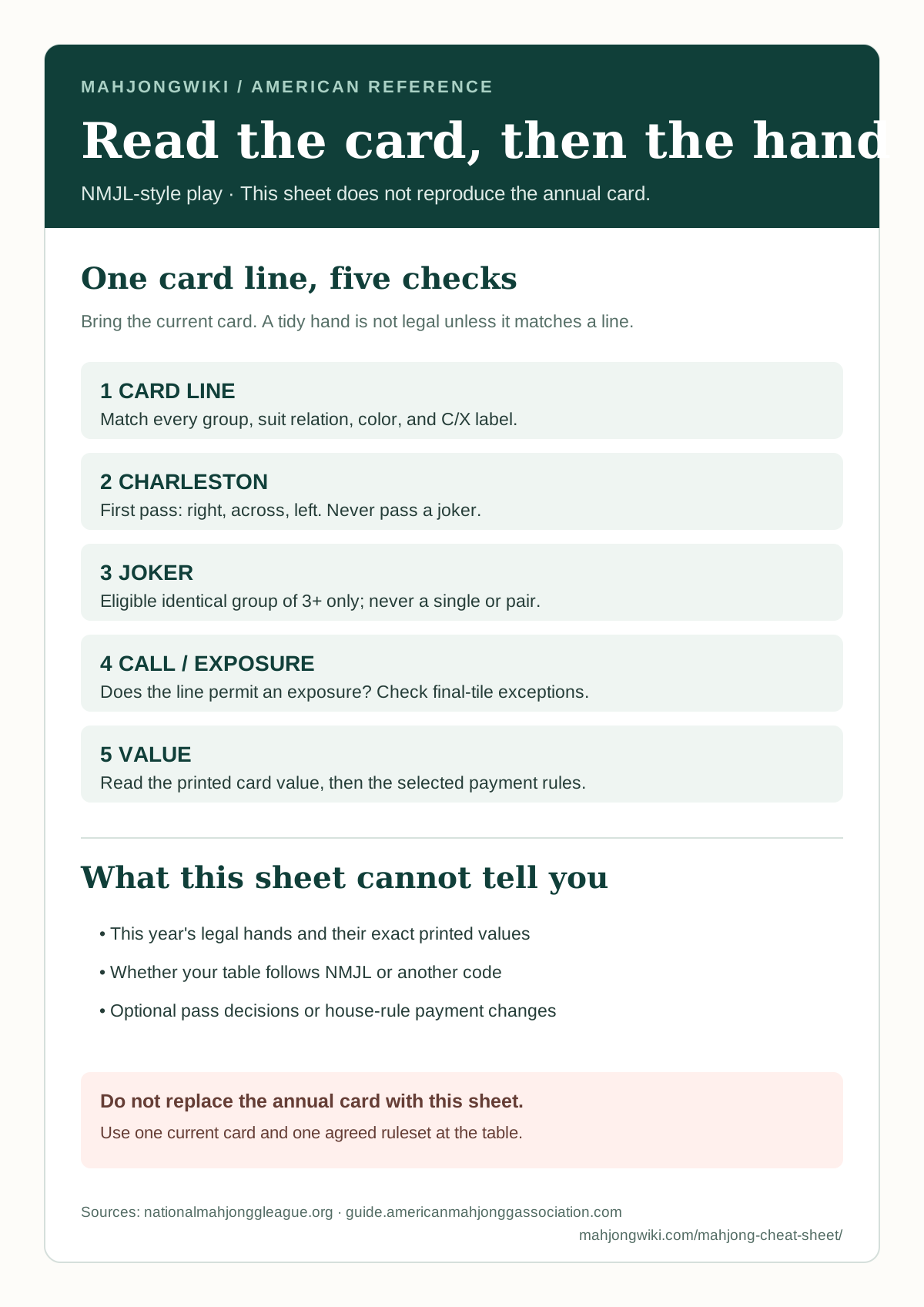
Keep the current annual card beside this reference; it never substitutes for a legal hand line.
- Match every tile group, suit relationship, and C/X label.
- Check Charleston, calls, and where jokers are permitted.
- Use the card's printed value, then the chosen rules for payment.
Variant check: Hong Kong, Chinese regional, riichi, American, and house rules differ on calls, special hands, minimum value, and scoring. Agree on one ruleset before the first deal.
Watch: Learn how to play mahjong in 2.5 minutes
Video by South China Morning Post.
This mahjong cheat sheet offers three separate downloads: a shared tile-and-turn reference, a riichi decision sheet, and an American card-check sheet. Use the one that matches your table. None replaces its full rules, scoring table, or current annual card.
How to print or save the mahjong cheat sheet
Use Download shared-core sheet, Download riichi sheet, or Download American sheet for a one-page, scalable SVG. Open a download in your browser and print it, or select Print or Save as PDF on this page. Portrait mode works for most printers; reduce the scale if yours adds wide margins.
Each printable is intentionally text-based and high contrast. The American sheet does not copy a commercial card; neither variant sheet pretends to be a complete scoring rulebook.
Mahjong points cheat sheet: choose the system first
There is no universal mahjong point total. A useful mahjong points cheat sheet starts by naming the ruleset, because Hong Kong fan, MCR points, riichi han and fu, and an American card value are different units. Never carry a number from one column into another.
Use this order at the table:
- Confirm the hand is structurally complete under the chosen rules.
- Check the minimum needed to win: table fan, 8 MCR points, at least 1 riichi yaku, or an exact current-card line.
- Count only combinations recognized by that ruleset.
- Apply limits, dealer treatment, and payment rules from the same source.
Mahjong points chart: what to count
| Ruleset | First legality check | Value unit | Final source |
|---|---|---|---|
| Hong Kong | Complete shape plus the table’s minimum | Fan | The local fan and payout chart agreed before play |
| MCR | At least 8 recognized points | Points | The official MCR combination table |
| Riichi | At least 1 yaku | Han and fu | A riichi payment table after limits and dealer status |
| American | Exact current-card line | Printed card value | The current card plus the table’s general rules |
This mahjong points chart is a routing tool, not a conversion table. For worked values and settlement examples, continue to the mahjong scoring guide.
A 14-tile example can fail four different ways
Suppose a player lays out four groups and a pair. The shape is visible, but the table should not pay automatically. The same-looking rack has a different next test under each ruleset:
| At this table | The additional question | Result if the answer is no |
|---|---|---|
| Hong Kong with a stated minimum | Does the hand reach that table’s agreed fan threshold? | A complete shape may be below the minimum |
| MCR | Do recognized patterns total at least 8 points? | The 14-tile arrangement is not a legal MCR win |
| Riichi | Is there a yaku, before counting dora? | Dora alone cannot qualify the hand |
| American | Does every tile fit one current-card line with the correct exposure status? | Four groups and a pair does not substitute for a card line |
This diagnostic table belongs beside the beginner lesson, not in place of it. For an actual opening hand, check the deal first; for a disputed cross-variant claim, use the American-versus-Chinese comparison to identify which rule belongs to which game. The questions are deliberately different because the winning conditions are different.
How to read the tile key
Dots, Bamboo, and Characters are numbered from 1 through 9. The graphic key avoids Chinese glyphs: circles identify Dots, slim marks identify Bamboo, and a red number with the label “CRAK” identifies Characters.
The 7 honor types are East, South, West, North, Red dragon, Green dragon, and White dragon. Honors can make pairs, pungs, and kongs, but not numbered sequences.
What “4 groups + 1 pair” means
A common complete hand has 4 groups and 1 pair:
- A chow is 3 consecutive tiles in the same numbered suit.
- A pung is 3 identical tiles.
- A kong is 4 identical tiles but occupies 1 group position.
- A pair is 2 identical tiles.
This formula is a shared starting point, not a universal win declaration. Seven Pairs, Thirteen Orphans, and American card combinations can use different structures.
The win check beginners skip
A complete-looking shape may still fail the ruleset’s value requirement. Riichi requires at least 1 yaku; dora alone does not provide it. Hong Kong and Chinese regional tables may set a minimum fan. American mahjong requires an exact line from the current card, including any concealed or exposure label.
Before declaring, check shape, minimum value, restrictions, and the table’s scoring source. This 4-step pause prevents more confusion than memorizing a long list of rare hands.
Riichi mahjong cheat sheet
The printable riichi sheet is a decision sequence, not a list of all winning patterns. Start with the hand’s shape and open/closed status. Then ask whether it has a yaku. A complete shape with only dora cannot win. Check furiten before declaring ron; a self-drawn tsumo is a separate path.
| Check | Ask at the table | If it passes |
|---|---|---|
| Hand | Is the shape complete under this riichi code? | Test yaku before counting bonus tiles. |
| Yaku | Does the hand have at least one recognized yaku? | Record open/closed conditions and han. |
| Win method | Ron or tsumo? Is ron blocked by furiten? | Apply the chosen code’s win procedure. |
| Value | Any dora or red-five bonuses? What fu and limits apply? | Use that code’s payment table, including dealer status. |
Track seat wind and round wind when evaluating wind-related yaku. The sheet deliberately does not print fixed payments: han, fu, limits, dealer status, and win method all matter.
Use Riichi Mahjong Rules and the Mahjong Score Calculator for the next step. The World Riichi Championship rules provide a documented code; confirm whether your table uses that edition or different optional rules.
American mahjong cheat sheet
The printable American sheet helps you read and verify a hand against the current card. It cannot replace that copyrighted, annually issued reference. Use the official National Mah Jongg League card and rules, or the governing code selected by your group.
| Check | Ask at the table | If it passes |
|---|---|---|
| Card line | Do all groups, suits, and colors match one complete line? | Check its concealed/exposed C or X label. |
| Charleston | Were passes made in the agreed sequence without jokers? | Begin regular turns under the selected rules. |
| Joker | Is it in an eligible group of three or more identical tiles? | Never use it for a single or pair. |
| Call and win | Is an exposure allowed, or is this the final tile for Mah Jongg? | Confirm the exact line, then read its printed value. |
The joker reminder follows the American Mah Jongg Association’s joker guide; check your own card and table’s governing rules for exceptions. A concealed card line is not permission to expose a group during ordinary play.
The sheet focuses on stable reminders: match the printed combination, observe concealed/exposed labels, apply joker restrictions, and follow Charleston procedure. For card-reading help, continue to American Mahjong Card 2026.
When searches say “mahjong cheat” or “mahjong cheats”
Here, mahjong cheat and mahjong cheats mean quick-reference aids, not ways to break the rules. Use the sheet to remember the turn sequence and the correct scoring source. It should never reveal another player’s concealed tiles, alter a wall, or replace an annual card or official rulebook.
Keep the sheet beside the table until the draw–check–discard rhythm feels automatic. Then use it only at genuine decision points; a reference should reduce friction, not interrupt every turn.
Frequently asked questions
Can I save this mahjong cheat sheet as a PDF?
Yes. Open any of the three downloadable SVG sheets in your browser and print it to PDF. Or choose Print or Save as PDF on this page for the full article and reference panels.
Which rules does the cheat sheet use?
The shared sheet covers the common four-groups-and-a-pair structure. Separate riichi and American downloads provide variant-specific checks, but their full rules and scoring still require the chosen rulebook or current card.
Does the sheet include every mahjong hand?
No. It is a turn and legality reference, not a complete scoring catalog. Special hands, yaku, card combinations, and local limits belong in the relevant ruleset guide.
Why are there no Chinese characters on the graphic tiles?
The visual key uses dots, bamboo marks, Latin letters, and numbers so English-language beginners can scan it quickly. Standard suit names remain in the text.